
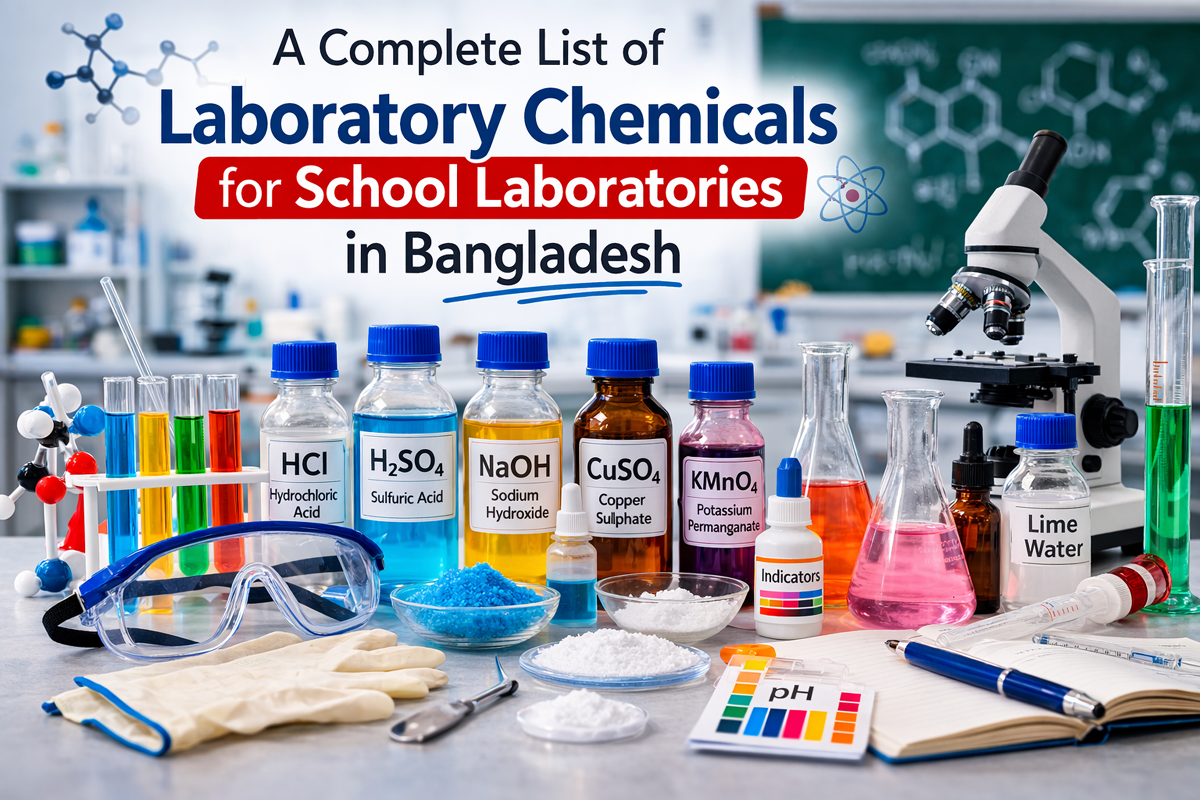
Science education becomes far more effective when students perform experiments instead of only reading theory. In Bangladesh, school laboratories allow students to observe scientific principles directly through practical activities. Chemistry, biology, and general science classes rely heavily on laboratory experiments, and these experiments require specific chemicals. This guide presents A List of Lab Chemicals for School laboratories in Bangladesh, along with their uses, safety tips, and storage recommendations.
Therefore, every secondary and higher secondary school should maintain a well-equipped laboratory with the necessary reagents and materials. Without the correct chemicals, students cannot perform many experiments described in the National Curriculum and Textbook Board (NCTB) syllabus.
Why Laboratory Chemicals Are Important for School Education
Laboratory chemicals support practical science learning. When students perform experiments themselves, they understand scientific concepts more clearly.
First, laboratory work connects theoretical knowledge with real-life observation. Students see chemical reactions, color changes, and gas formation directly in front of them.
Second, practical experiments develop analytical and problem-solving skills. Students measure substances, record results, and analyze experimental outcomes.
Moreover, laboratory practice prepares students for higher education. Colleges and universities expect students to have basic laboratory skills before entering advanced science courses.
Finally, practical experiments increase curiosity and interest in science. When students observe exciting reactions, they develop a deeper interest in chemistry and scientific discovery.
Major Categories of Laboratory Chemicals Used in Schools
School laboratories use chemicals for different types of experiments. For easier understanding, teachers usually group them into several categories.
The most common categories include:
- Acids
- Bases and alkalis
- Salts
- Indicators
- Oxidizing and reducing agents
- Organic chemicals
- Biological reagents
- Cleaning and safety chemicals
Each group plays a specific role in laboratory experiments.
Common Acids Used in School Laboratories
Acids represent one of the most frequently used types of laboratory chemicals. Teachers often use them to demonstrate reactions, prepare salts, and conduct titration experiments.
Hydrochloric Acid (HCl)
Hydrochloric acid appears in many school experiments. Teachers frequently use diluted hydrochloric acid to demonstrate reactions between acids and metals.
For example, zinc reacts with hydrochloric acid to produce hydrogen gas. Because of this reaction, students learn how acids interact with metals.
Additionally, hydrochloric acid helps in salt preparation and pH experiments.
Sulfuric Acid (H₂SO₄)
Sulfuric acid serves as another important reagent in chemistry laboratories. Teachers usually use diluted sulfuric acid for educational experiments.
This acid helps students observe dehydration reactions and electrolysis experiments. Moreover, sulfuric acid plays an important role in preparing various sulfate salts.
Nitric Acid (HNO₃)
Nitric acid also supports several school laboratory experiments. Teachers often use it when demonstrating reactions with metals or preparing nitrate salts.
Furthermore, nitric acid assists in qualitative chemical analysis.
Acetic Acid (CH₃COOH)
Acetic acid represents a weak organic acid. Because of its mild properties, teachers often use it to explain the differences between strong and weak acids.
Students also observe its characteristic vinegar smell during experiments.
Oxalic Acid
Oxalic acid commonly appears in redox titration experiments. Many teachers use it when performing reactions with potassium permanganate.
Boric Acid
Boric acid works well in flame tests and simple chemical demonstrations. In addition, it appears in some basic chemistry experiments involving weak acids.
Bases and Alkalis Used in School Laboratories
Bases neutralize acids and help demonstrate many important chemical reactions. For this reason, school laboratories require several alkaline chemicals.
Sodium Hydroxide (NaOH)
Sodium hydroxide, often called caustic soda, acts as a strong alkali. Teachers frequently use it in acid-base titration experiments.
Furthermore, sodium hydroxide supports soap preparation demonstrations and precipitation reactions.
Potassium Hydroxide (KOH)
Potassium hydroxide functions similarly to sodium hydroxide. However, teachers sometimes choose potassium hydroxide for specific chemical reactions.
Calcium Hydroxide (Limewater)
Calcium hydroxide solution, known as limewater, plays an important role in carbon dioxide detection experiments.
When carbon dioxide passes through limewater, the solution turns milky. As a result, students easily recognize the presence of carbon dioxide.
Ammonium Hydroxide (NH₄OH)
Ammonium hydroxide produces ammonia in solution. Teachers often use it in qualitative analysis experiments.
Additionally, ammonium hydroxide helps demonstrate precipitation reactions.
Important Salts for School Laboratory Experiments
Salts represent another important group of chemicals in school laboratories. Teachers use them to demonstrate crystallization, precipitation, and ionic reactions.
Copper Sulphate (CuSO₄)
Copper sulphate forms bright blue crystals. Because of its distinctive color, teachers frequently use it to demonstrate crystal formation.
Moreover, copper sulphate helps students observe hydrated and anhydrous salts.
Sodium Chloride (NaCl)
Sodium chloride, commonly known as table salt, appears in several school experiments. For instance, teachers often use it during electrolysis demonstrations.
Potassium Nitrate (KNO₃)
Potassium nitrate helps students study solubility and temperature effects on crystals.
Ammonium Chloride (NH₄Cl)
Ammonium chloride sublimates when heated. Therefore, teachers often use it to demonstrate sublimation processes.
Sodium Carbonate (Na₂CO₃)
Sodium carbonate participates in acid-base reactions and salt preparation experiments.
Sodium Bicarbonate (NaHCO₃)
Sodium bicarbonate reacts with acids to release carbon dioxide gas. Consequently, students observe gas evolution reactions easily.
Calcium Carbonate (CaCO₃)
Calcium carbonate reacts strongly with acids. Teachers often use marble chips or limestone for this purpose.
Indicators Used in School Chemistry Laboratories
Indicators help determine whether a solution is acidic or alkaline. In other words, they show pH changes through color variations.
Litmus Indicator
Litmus serves as the most basic acid-base indicator.
Blue litmus paper turns red in acidic solutions. Conversely, red litmus paper turns blue in alkaline solutions.
Phenolphthalein Indicator
Phenolphthalein works well in titration experiments.
The solution remains colorless in acidic conditions. However, it turns pink in alkaline solutions.
Methyl Orange
Methyl orange also functions as an acid-base indicator. Teachers commonly use it in titration experiments.
Universal Indicator
Universal indicator provides a wide range of colors corresponding to different pH levels. Consequently, students can estimate the approximate pH of solutions.
Starch Indicator
Starch solution appears frequently in iodine experiments. It produces a deep blue color in the presence of iodine.
Oxidizing and Reducing Agents
Some chemicals help demonstrate oxidation and reduction reactions.
Potassium Permanganate (KMnO₄)
Potassium permanganate acts as a strong oxidizing agent. Its deep purple color also makes reactions visually interesting.
Teachers often use potassium permanganate in redox titration experiments.
Potassium Dichromate (K₂Cr₂O₇)
Potassium dichromate also functions as an oxidizing agent. It appears in redox reactions and chemical analysis experiments.
Hydrogen Peroxide (H₂O₂)
Hydrogen peroxide decomposes into water and oxygen gas. Therefore, teachers frequently use it to demonstrate decomposition reactions.
Organic Chemicals Used in School Laboratories
Organic chemistry experiments require simple organic compounds.
Common examples include:
- Ethanol
- Methanol
- Glucose
- Urea
- Glycerin
- Formalin
For example, glucose helps students perform sugar detection tests. Similarly, ethanol works well as a solvent in many laboratory reactions.
Biological Laboratory Chemicals
Biology laboratories also require several chemical reagents.
Important examples include:
- Iodine solution
- Benedict’s solution
- Fehling’s solution
- Sudan stain
- Methylene blue
Teachers use these chemicals to perform food tests and microscope staining experiments.
Cleaning and Safety Chemicals
Laboratory maintenance requires additional chemicals for cleaning and sanitation.
Common examples include:
- Distilled water
- Bleaching powder
- Sodium hypochlorite
- Ethanol disinfectant
- Laboratory detergents
These chemicals help maintain a safe and hygienic laboratory environment.
Laboratory Safety Guidelines for Schools
Chemical safety should always remain a top priority in school laboratories.
Teachers must instruct students to follow important safety rules. For example, students should wear laboratory coats, gloves, and safety goggles during experiments.
Additionally, laboratory staff must label every chemical container clearly. Proper labeling prevents confusion and reduces accidents.
Schools should also store acids, bases, and flammable chemicals in separate cabinets. Furthermore, teachers must supervise all experiments carefully.
When schools follow these guidelines, laboratory activities remain safe and effective.
Where Schools Can Buy Laboratory Chemicals in Bangladesh
Schools need reliable suppliers to maintain laboratory chemicals. Quality, purity, and proper packaging matter greatly when purchasing laboratory reagents.
Educational institutions should choose suppliers that provide certified chemicals and safe delivery.
Labtexbd.com offers a convenient platform for purchasing laboratory chemicals and scientific equipment in Bangladesh.
Schools can find:
- Chemistry laboratory chemicals
- Biology laboratory reagents
- Laboratory glassware and instruments
- Science laboratory kits for schools
Moreover, the platform offers reliable delivery services across Bangladesh.
Conclusion
School laboratories play a vital role in science education. Students learn more effectively when they perform experiments and observe chemical reactions firsthand.
For this reason, schools must maintain a complete set of laboratory chemicals. Acids, bases, salts, indicators, and organic reagents all support different types of experiments in the classroom.
By equipping laboratories with the right chemicals and following proper safety guidelines, schools can create an engaging environment for scientific learning.
Institutions in Bangladesh that wish to purchase reliable laboratory chemicals can explore trusted suppliers such as Labtexbd. With the right laboratory resources, students gain valuable practical knowledge that strengthens their understanding of science.